Celebrations of the television centenary at 22 Frith Street
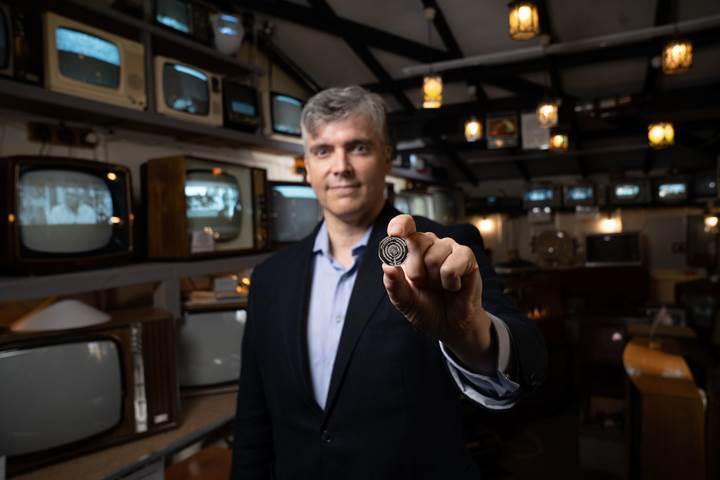
Below is the full text of Malcolm Baird's recorded address, played for the guests at the Television Centenary on 26 January 2026 at Bar Italia & Little Italy 22 Frith Street, Soho (London W.1) to mark the centenary of his father's first formal demonstration of television. For reasons of age and health, he was unable to attend. His son, Iain Logie Baird, a TV historian and museum curator, was able to travel down from his home in Yorkshire to unveil a new World Origin Site plaque on the front of the building and to officially open a newly refurbished dining space on the first floor, the Baird Room.
“He [John Logie Baird] developed the first working television system, not just in the UK but in the world. He solved the problem of television here in this building,” said Iain Logie Baird, as he unveiled the plaque. Guests at the well-attended event included: former newsreaders Angela Rippon and Moira Stuart John Altman, who played EastEnders bad boy Nick Cotton sitcom stars of yesteryear Hi-de-Hi!’s Su Pollard, Melvyn Hayes (It Ain’t Half Hot Mum) and Vicki Michelle (’Allo ’Allo!) along with the veteran DJ Mike Read.
***
May I add a few words to mark the 100th anniversary of my father’s first television demonstration, here in Soho.
Sometimes people ask me why I didn’t follow his footsteps and enter the television industry. To put it mildly, he was a hard act to follow. Instead I became interested in industrial chemistry as a teenager in 1950. I was encouraged by that great British comic film, The Man in the White Suit. I took up a chemical engineering career in Canada but as the years passed, television history became my absorbing hobby. In the last few years I have been taking a look at the evolution of television since its unveiling in 1926.
The first factor has been science and technology. The original television system was optical and mechanical, with electronics used for amplification. Much has been said and written about the limitations of mechanical television, but we must not forget that in February 1928, only a couple of years after the original demonstration here in Soho, a recognizable mechanical television signal was sent from London to New York. A few years later, television developed to become all-electronic, using cathode ray tubes. This system was in place until the 1970s and it saw the birth of television as a mass medium.
The second great force affecting television was economics. At first it was very expensive. In the late 1940s, the UK price of a new television set was about £70, which amounted to three months’ earnings for an average worker. But soon, the financial impact was reduced by receiver rentals and hire purchase arrangements. Later, the manufacture of television sets moved away from high-cost countries such as the UK and the USA.
Television became a mass medium, drawing its income from advertisements and from the license fees of broadcasters such as the BBC. Some people look back to this time as a golden age. Roy Thompson described a broadcasting licence as ”a permit to print money”. Popular programmes included drama, music, quiz shows and (above all) sport. Each category had its own cadre of expert performers and personalities viewing numbers were often in the high millions.
While the television boom went on, research on science and technology continued in the background. For many years the workhorses of television had been thermionic valves and cathode ray tubes, but by the 1980s they were mainly replaced by solid-state devices. These were cheaper and less failure-prone than the tubes which required heated filaments. It also became possible to transmit digital signals. These do not have the problem of interference. which had limited the number of channels that could be broadcast simultaneously in any area.
The technical advantages of the new devices, and their much lower cost, have led to the formation of the internet. It has become possible for an ordinary person to send (as well as receive) signals. The old-style centralised systems had employed a few heavily-regulated and expert broadcasters reaching out to audiences in the millions, but now the television industry, as we knew it, has become fragmented. For many years seen as a competitor of the film industry, now it is tending to merge with it. There is an acute oversupply of good and experienced actors and production staff.
I have mentioned three important factors in the history of television: technology, economics and programme production. In the new fragmented state of the medium, a fourth factor emerges: human nature. There is much less distinction between the programme makers and the viewers than ever before. Human nature faces new tests as television enters its second century and it is difficult to predict the future with confidence.
The most optimistic prediction would be a new era of world peace and understanding: in my father’s words, television would become “tomorrow’s diplomat”. On the other hand, a pessimist might expect anarchy or perhaps an Orwellian dictatorship in which our viewing habits are monitored by governments or big business, or both. One thing is certain: we can all look forward to interesting times.